A few years ago, sending a simple token transfer on Ethereum during a busy period could cost more than the amount being sent. Swapping tokens on a decentralized exchange might cost a user in Kampala the price of a week's lunch. For anyone hoping blockchain would power everyday payments, remittances or games, that was a serious problem.
Today, most of that activity has moved somewhere else. The same transfer on a Layer 2 network typically costs a fraction of a cent and confirms in seconds, while still settling back to Ethereum for security.
That shift is one of the most important developments in blockchain, and it is the reason real-world applications are finally practical. Here is how Layer 2 scaling works, what has changed, and what it means for businesses building on blockchain.
The problem: blockchains are slow by design
A public blockchain like Ethereum is secure because thousands of independent computers check every transaction and keep a copy of the full history. No single company controls it, and no one can quietly rewrite the record.
That same design is what makes it slow. When every node has to process every transaction, the network can only handle a limited amount of activity. When demand rises, users compete for limited space by paying higher fees, and the cheapest transactions wait.
This tension is often called the blockchain trilemma: it is hard for a single network to be highly secure, highly decentralized and highly scalable all at once. Making the base layer faster usually means asking fewer, more powerful computers to run it, which weakens the decentralization that makes it trustworthy in the first place.
Why scale matters beyond crypto
Scalability is not an abstract engineering concern. It decides which products can exist.
- Payments and remittances. A cross-border payment tool is pointless if the fee eats a meaningful share of a small transfer.
- Stablecoins for everyday use. Businesses and individuals increasingly use dollar-pegged stablecoins to hold value and pay suppliers. That only works if moving them is cheap and fast.
- Games and loyalty programs. Applications that create many small transactions per user cannot survive high per-transaction costs.
- Supply chain and traceability. Recording every handoff of a coffee shipment from farm to export only makes sense if each record costs almost nothing.
Without scaling, blockchain stays a tool for large-value transactions and specialists. With it, blockchain can serve the kinds of users and use cases that matter in markets like Uganda.
The answer: move execution off the main chain
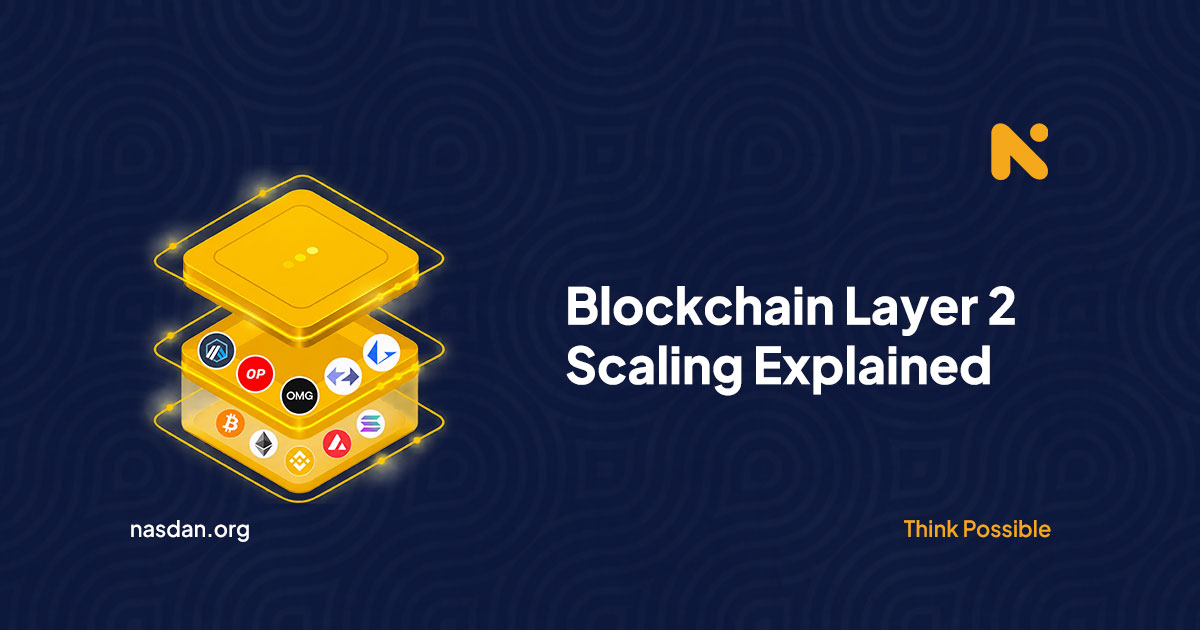
Layer 2 networks take a simple but powerful idea: do most of the work somewhere else, then use the main chain (Layer 1) only for what truly needs its security.
A Layer 2 processes transactions on its own, batches thousands of them together, and posts a compact record back to Ethereum. Ethereum acts as the court of final appeal. It stores the data needed to reconstruct the Layer 2's state and enforces the rules if anyone tries to cheat.
The result is that users get speed and low fees from the Layer 2, while their funds remain protected by the security of the Layer 1 underneath.
The main types of Layer 2
Optimistic rollups
Optimistic rollups assume transactions are valid by default and post them to Ethereum. Anyone watching can challenge a suspicious batch during a dispute window by submitting a fraud proof. If the challenge succeeds, the bad batch is reversed and the dishonest party is penalized.
They are relatively simple to build and highly compatible with existing Ethereum smart contracts, which is why many of the largest Layer 2 networks, including Arbitrum, Optimism and Base, use this approach. The trade-off is that withdrawing funds directly back to Ethereum can take around a week, although third-party bridges usually make this much faster in practice.
Zero-knowledge rollups
Zero-knowledge (ZK) rollups take the opposite approach. For every batch, they generate a cryptographic validity proof showing mathematically that all the transactions were executed correctly. Ethereum verifies the proof, and the batch is final.
Because nothing needs to be challenged, withdrawals can be much faster, and the cryptography opens the door to privacy features. Generating proofs used to be slow and expensive, but improvements in proving systems and hardware have made ZK rollups, including zkEVMs that run standard Ethereum code, increasingly practical. Many in the industry see ZK proofs as the long-term direction for rollups.
State channels
State channels let two parties transact privately and instantly off-chain, settling only the opening and closing balances on the main chain. They suit repeated interactions between the same participants, such as streaming micropayments, but they are less flexible for open applications with many users. Bitcoin's Lightning Network is the best-known example.
Sidechains and validiums
Sidechains are separate blockchains connected to the main chain by a bridge. They can be very fast and cheap, but they run their own security, so users must trust the sidechain's validators rather than Ethereum itself. Strictly speaking, they are not Layer 2s.
Validiums sit in between: they use validity proofs like ZK rollups, but keep transaction data off Ethereum to cut costs further. That makes them attractive for high-volume applications, at the cost of relying on whoever stores the data.
When evaluating any network, the key question is simple: if something goes wrong, can users still recover their funds using the main chain alone? Independent trackers such as L2BEAT rate networks on exactly this kind of question, and they are worth checking before choosing where to build.
What changed recently
Two trends have reshaped Layer 2 over the past few years.
Ethereum started building for rollups. In March 2024, Ethereum's Dencun upgrade introduced "blobs" (EIP-4844), a cheaper, dedicated space for rollups to post their data. Layer 2 fees dropped dramatically almost overnight, and later upgrades have continued to expand that capacity. Ethereum is now explicitly designed as a secure settlement layer, with most user activity happening on rollups above it.
Launching a chain became easier. Open frameworks and rollup-as-a-service providers now let organizations launch their own application-specific rollup. A fintech, a game studio or even a government programme can run a dedicated chain with its own rules, fee model and access controls, while still settling to Ethereum.
What Layer 2 makes possible
For businesses and developers, the benefits are concrete:
- Higher throughput. Rollups process far more transactions than Ethereum alone, so applications stay responsive as they grow.
- Low, predictable fees. Costs measured in fractions of a cent make micropayments, frequent interactions and mass-market apps viable.
- Better user experience. Fast confirmations and cheap transactions remove much of the friction that once pushed users away.
- Ethereum-grade security. Well-designed rollups inherit the protection of the most battle-tested smart contract network.
- Customization. Dedicated rollups can add permissioning, privacy controls or compliance features that regulated industries need.
What to watch out for
Layer 2 is powerful, but it is not free of trade-offs, and good engineering means being honest about them.
- Centralized sequencers. Many rollups still rely on a single operator to order transactions. That operator cannot steal funds on a well-built rollup, but it can delay or censor transactions.
- Bridge risk. Moving assets between chains through bridges has historically been one of the most exploited areas in crypto.
- Fragmentation. With many Layer 2s, users and liquidity are spread across separate networks, although interoperability work is steadily improving this.
- Upgrade controls. Some networks can still change their contracts quickly through a small group of keyholders, which is a form of trust users should understand.
Choosing the right network, or deciding whether to run your own, depends on your use case, your users and your regulatory environment.
Why this matters for Africa
Africa has already shown the world how quickly people adopt digital finance when it is useful and affordable. Mobile money changed everyday life in Uganda because it was cheap, fast and accessible.
Blockchain can follow the same path only if it meets the same standard. Layer 2 scaling is what brings transaction costs down to a level that works for small merchants, cross-border workers, farmers' cooperatives and young users, rather than only for large investors. It turns blockchain from a speculative asset class into usable infrastructure for payments, identity, traceability and digital services.
Building on Layer 2 with NASDAN
At NASDAN, our blockchain practice helps organizations turn these possibilities into working products. We design and build smart contracts in Solidity and Rust, decentralized applications using Web3.js, Ethers.js and Hardhat, and the integrations that connect blockchain to existing systems, including mobile money and traditional payment rails.
We help clients choose the right network for their needs, whether that is deploying on an established Layer 2 or launching a dedicated rollup, and we build security, compliance and user experience into the architecture from the first sprint.
Thinking about where blockchain fits in your business? Let's talk about what you want to build.